

Summary
(Marissa W Mitchel, Stefanie Turner, Lauren K Walsh, Rebecca I Torene, Scott M Myers, Cora M Taylor)
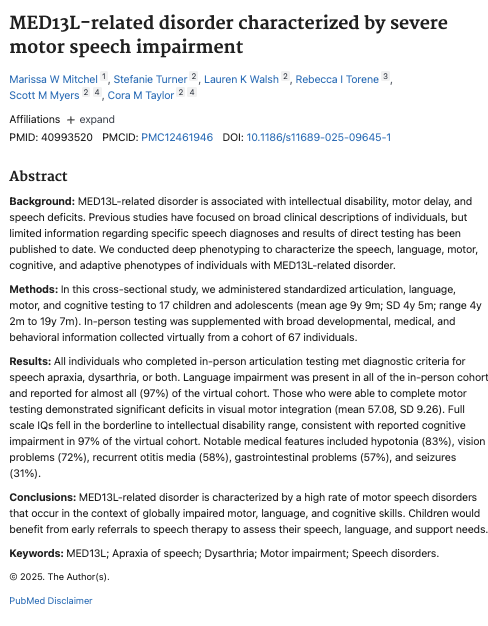
- The researchers studied the speech, language, motor, cognitive, adaptive, and behavioral features of Simons Searchlight participants with MED13L-related syndrome. They also included in-person research data collected in 2022 at a MED13L Family and Research Conference.
- Language and speech are different – language is the meaning, structure, and the way in which a person uses words, whereas speech is the physical movement and coordination of the lips, tongue, and breathing to produce sound.
- This study included 17 people from the in-person conference and 67 online participants with likely pathogenic and pathogenic MED13L variants.
- All in-person participants had a motor speech disorder, such as childhood apraxia of speech, dysarthria, or both. Childhood apraxia of speech is a speech disorder caused by a problem with communication between the brain and the muscles used for speaking. Dysarthria is a speech disorder that results when the muscles used to speak become paralyzed or weakened. Everyone had severe impairment in receptive language (ability to understand language) and expressive language (ability to express yourself).
- All in-person participants had intellectual disability, and when they were able to be measured, non-verbal IQ scores were higher than verbal IQ scores. They also had deficits in visual motor integration.
- Most Simons Searchlight participants with MED13L-related syndrome reported having a language disorder (65 out of 67 people or 97 percent). One out of 3 children were minimally verbal or non-verbal after the age of 4.
- In-person assessment of gross and fine motor deficits were comparable to what was reported through online data collection.
- Motor speech disorders were common in the study participants, and this was considered to be consistent with a muscular/mechanical defect rather than a purely cognitive defect.
- The researchers collected the medical history shared with Simons Searchlight. Commonly reported issues included low muscle tone in 50 out of 60 people (83 percent); gastrointestinal problems, including constipation, gastroesophageal reflux, and diarrhea in 34 out of 60 people (57 percent); and vision problems in 43 out of 60 people (72 percent). About 1 in 3 people reported seizures (20 out of 65 people or 31 percent), and 63 out of 65 people (97 percent) reported some degree of cognitive impairment and a language disorder diagnosis. Some participants had autism spectrum disorder (28 out of 57 people or 49 percent) and attention-deficit/hyperactivity disorder (13 out of 60 people or 22 percent).
- The researchers suggested that there might be a higher rate of germline mosaicism in the MED13L community. Germline mosaic is when a person’s egg cells or sperm cells carry the same genetic variant, but that person does not have that variant detected in blood.
- The researchers also suggested that children with MED13L-related disorder might benefit from a referral to speech therapy to assess their needs.