

Summary
(Emily F Ferguson, Thomas W Frazier, Antonio Y Hardan, Mirko Uljarević)
- 2025
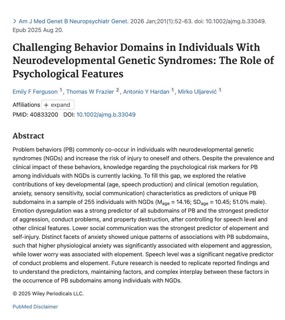
- The researchers studied problem behaviors, such as property destruction, aggression, elopement, conduct problems, and self-injury, in participants with neurodevelopmental genetic syndromes.
- The researchers recruited participants aged 3 to 45 with GRIN2B, CSNK2A1, HIVEP2, SCN2A, MED13L, ADNP, and STXBP1. The participants were recruited through Simons Searchlight and other patient advocacy foundations and non-profits.
- The participants took five surveys that assessed problem behaviors, emotion regulation, anxiety, sensory sensitivity, and social communication.
- The researchers found that emotion dysregulation was a strong predictor of aggression, conduct problems, and property destruction.
- Lower levels of social communication was the strongest predictor of elopement and self-injury.
- Different types of anxiety, such as worry or physiological, had their own associations with problem behaviors. Higher physiological anxiety, a racing heart, and being sweaty, flush, or shacky were strongly associated with elopement and aggression. Having lower worry was associated with elopement.
- Lower levels of speech abilities was a predictor for conduct problems and elopement.
- The researchers suggested that supporting a person through problem behaviors may require multi-faceted interventions for the child and the family, as there are links between the different behaviors. The individual’s needs, preferences, and risk of harm that may result from behaviors should be considered.